


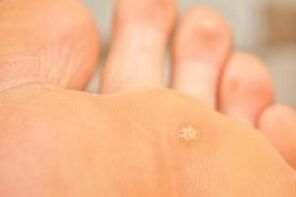
Plantar warts can bring many unpleasant and sometimes very painful sensations to their owner.There are many ways to treat plantar warts: surgical removal, medication, physiotherapy.Traditional medicine has shown good effectiveness in solving this problem;its secrets are quite simple and the ingredients are quite accessible to everyone.What a plantar wart looks like, the reasons for its appearance and methods of treatment will be discussed in the article.
Causes of plantar warts
Spikes, or plantar warts, are a serious skin defect in the form of flat, scaly formations that can appear singly or in groups on any part of the body, but most often occur on the feet and palms.Plantar warts create the greatest discomfort;they can completely deprive a person of the ability to move.
Generally, young people aged 20 to 30 are exposed to this scourge, although the appearance of thorns has been noted in both the elderly and children.The main cause of this pathology is the human papillomavirus, which spreads quickly between people and is quite aggressive.
Plantar warts do not have an incubation period.In patients with a weakened immune system, the disease may appear a few days after contact with a carrier of the infection;With a healthy immune system, warts have almost no chance of appearing.
Factors, criteria and causes of plantar warts:
- Increased dryness of the skin of the feet, decrease in pH, which protects the epidermis;
- Low immunity;
- Vegetative-vascular diseases, in which cyanosis of the extremities is noted;
- Plantar skin injuries;
- Endocrinological diseases;
- Excessive sweating of the feet;
- Very tight and uncomfortable shoes, made with poor quality materials;
- Hormonal disorders.
These conditions not only contribute to the appearance of warts and their subsequent proliferation, but can also significantly complicate treatment, which in each specific case should be aimed at both eliminating the tumor itself and eliminating the initial cause.
Symptoms of plantar warts
A plantar wart is a rather unpleasant tumor, the taproot of which penetrates deep into the tissues and at the same time exerts pressure on the nerve cells.As a result, painful sensations appear, which intensify when walking, and even more so when moving in shoes.
The main symptoms of plantar warts:
- Thickenings on the skin that look like calluses;
- Small growths appear on the sole of the foot;
- Pain when touching the infected area and walking;
- In a certain area of the sole, a change in skin color occurs.
The initial stage is characterized by the appearance of fleshy and smooth growths on the sole of the foot;the color of the skin around the lesion becomes abnormally dark or, on the contrary, becomes very light.At first there is no pain, then it occurs when pressing on the infected area, and later it intensifies when touching and walking.
Over the course of about a month, another daughter formation usually appears near the first wart, but sometimes they appear simultaneously in a group of several lumps.These neoplasms cause a lot of inconvenience and disrupt the normal rhythm of life;in some cases, a person is completely deprived of the ability to move independently, which leads to a loss of performance.
How to treat a plantar wart with folk remedies?
Traditional medicine methods have proven to be excellent in solving this problem.Tools and components for their implementation are very often found in every kitchen and in any garden.The most effective traditional methods for treating plantar warts:
- Grind one medium onion into a paste and mix with vinegar.Cover the healthy skin around the wart with a bandage to avoid burns, apply the resulting composition to a piece of cotton wool, which must be fixed with a plaster or bandage at the site of infection.It is advisable to apply this compress before going to bed throughout the night.The wart gradually disappears after the second compress;you can get rid of it completely in a very short time.
- Instead of onions mixed with vinegar, you can apply a plate of horseradish root or a piece of garlic to the infected area.The effect will be the same.
- Celandine has been used to remove warts since ancient times.To completely get rid of it, it is necessary to lubricate the infected area with the juice of this plant 5-6 times a day.After 15 days there will be no traces of unpleasant formations.An alternative may be a herbal medicine, which can be purchased at any pharmacy along with instructions for use.It should be remembered that abuse of this medication can lead to the appearance of keloid scars.
- If a large part of the sole is infected with warts, fresh nettle can help.The ground plant should be placed on a burdock leaf and applied to the infected area.Secure with a bandage or sock, preferably woolen.Many of these procedures will permanently rid you of plantar warts.
- Lemon peel tincture can be easily made at home.Finely chop the skin of two lemons, add 100 g of vinegar.Infuse this composition for a week in a tightly closed container.Treat the infected area with the expressed infusion, avoiding contact with healthy skin, 3 times a day.
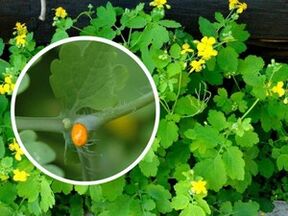
Before carrying out the procedures described above, you need to steam your feet for half an hour;you can pour a little soda into the water or add soap.A steamed sole is much more sensitive to this treatment, which guarantees rapid recovery.
Traditional medicine has been tested by the practice of many generations and, unlike modern medicines, has practically no contraindications.But if no improvement is seen after two weeks, then you should consult a doctor.
How to treat plantar warts with medication?
In some cases, plantar warts disappear on their own after a while.However, hoping for chance and waiting for a miracle, this disease can be triggered and it is usually possible to get rid of neoplasms at the initial stage quickly and easily, even at home.
The most common means of combating this disease is salicylic acid, which can be purchased at any pharmacy.No doctor's appointment or prescription is required.The liquid composition is applied to the infected area in the form of a compress 2 times a day.You can purchase a special patch;it is stuck on the area of the sole with rashes and is removed after two days.
Plantar warts are well treated with a special preparation for topical use, which contains the venom of beetles.Its use does not cause pain, however, a sort of blister may form in the treatment area, which opens and dries after a few days.
Treating plantar warts is a very long process that requires patience and perseverance.It is necessary to use a vitamin complex with medications for topical use, since immunity plays an important role in resolving this disease.
Removal of plantar warts
There are several methods for removing plantar warts in a clinical setting, all of them are painful to some extent, but they eliminate the problem in the shortest possible time.The main methods of removing tumors include:
- Any formation can be removed with a surgical scalpel;warts are no exception.The process itself is quite painful and must certainly be accompanied by anesthesia.
- With the help of a laser beam, the vessels near the infected area are cauterized, which leads to tissue necrosis and the wart, deprived of nutrition, dies.
- The electrocoagulation method involves cauterizing a tumor with a high-frequency current.The process itself takes from a few seconds to several minutes, everything will depend on the thickness and size of the growth.
Removal of plantar tumors is used in cases where other methods do not bring a positive effect.Often, after these procedures, scars remain, but these methods remove warts quickly and simultaneously with the roots.
Cryodestruction of a plantar wart
This method involves treating the tumor with liquid nitrogen at a temperature of -196 degrees.The cryodestruction method is expressed in the fact that when freezing, the part of the skin infected with viruses is destroyed with additional stimulation of the body's defenses.But it is worth noting that when a wart has appeared and persists for up to six months, the effectiveness of getting rid of it is about 85%.At the same time, the effectiveness of removing tumors existing for more than six months is reduced to 40%.
The cryodestruction process can be carried out:
- usually (liquid nitrogen is applied until a slight halo of several millimeters forms near the wart);
- aggressively (liquid nitrogen, after the formation of a slight halo around the wart, continues to be applied for another 5-20 seconds).
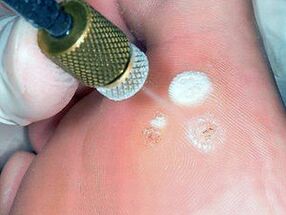
Studies have proven that the aggressive freezing method is more effective than the conventional method, but its downside is that it is much more painful.
After removing the wart, redness (hyperemia) of the skin with additional swelling is noted in the affected area.A few hours later, a blister appears on the infected area (it may contain serous or hemorrhagic fluid), and about a week after the blister dries, a crust appears on this area, which disappears on its own in 10-14 days.
Prevention measures and likely consequences
What is the danger if plantar warts are not treated?In the absence or inappropriate treatment, tumors can multiply and spread to other parts of the body: face, hands.The aesthetic aspect of the problem probably does not need comments, but treatment in this case will take much more time.
Any neoplasm can develop into a malignant form.It is therefore very dangerous to leave a plantar wart unattended.At the same time, carriers of the human papillomavirus are sources of infection for other people;their relatives are in the most likely risk group.
The importance of treating plantar warts is clear, but preventive measures should not be forgotten:
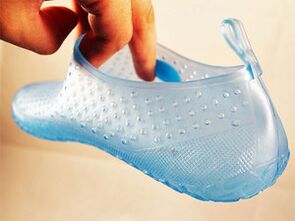
- Mandatory compliance with personal hygiene rules;
- Refusal of uncomfortable and tight shoes;
- Wear special individual shoes in common areas, such as sauna, public baths, swimming pool;
- Treatment of any damage to the skin of the sole (abrasions, wounds);
- Use of vitamin complexes;
- Maintain pH levels with hydrating foot care products.
Since the most important cause of this disease is viral infection, the main preventive measures should be aimed at maintaining the immune system.Therefore, the main recommendations are personal hygiene and a healthy lifestyle.